
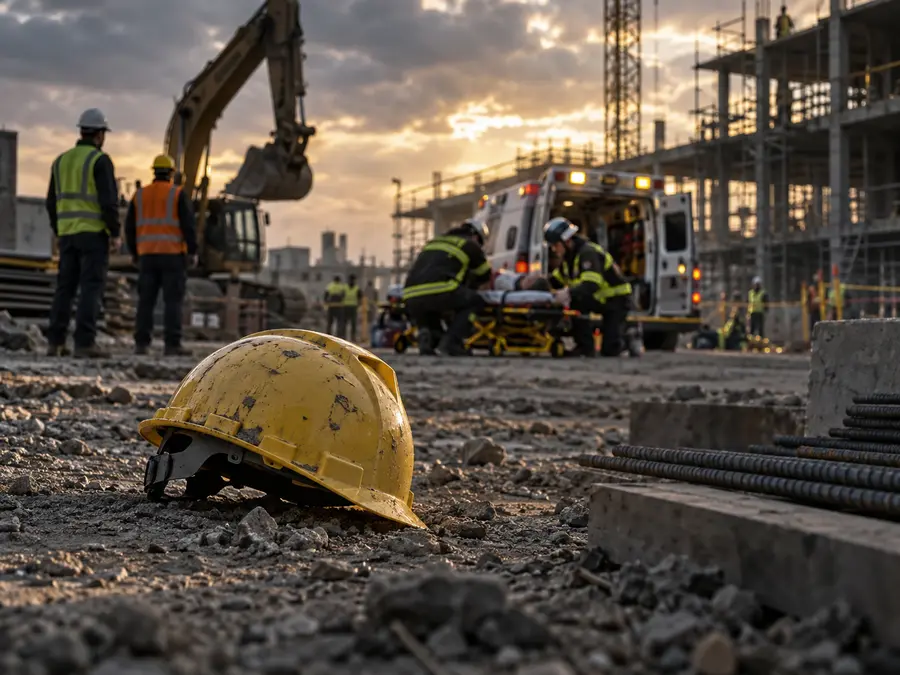
What Should I Do After a Construction Injury?
Construction injuries often happen on worksites where several companies share the project: an employer, general contractor, subcontractors, property owner, equipment vendor and others. Workers’ compensation usually begins with the injured worker’s employment relationship, while separate safety, third-party and serious-and-willful issues depend on different facts and legal standards.
- Get emergency or urgent medical care when needed. Do not delay necessary treatment to collect evidence.
- Report the injury to your employer and start the DWC-1 process. DWC states the employer must provide or mail the form within one working day after learning of the injury.
- Identify the companies on the site. Record the general contractor, your direct employer, subcontractors, staffing agency, property owner and equipment vendors when known.
- Preserve photographs, video, equipment identifiers, ladder/scaffold information, witness names and incident-report details.
- Keep every medical and work-status report, especially after surgery, hospitalization or major restrictions.
- Obtain early legal review when another entity may be responsible, the injury is severe, the employer disputes the claim, or evidence is likely to change.
A construction injury can involve more than one track
Workers’ compensation
Benefits and medical issues tied to the employment injury.
Third-party issues
Responsibility of another company, property owner, or equipment entity may require separate analysis.
Cal/OSHA record
Safety evidence and agency records may matter without replacing the workers’ compensation claim.
Employer/entity map
Identify the direct employer, general contractor, subcontractors, staffing entities, and equipment owners.
Workers’ Compensation and Cal/OSHA Are Different Systems
Cal/OSHA sets and enforces workplace-safety standards. Workers’ compensation provides benefits for qualifying work injuries and illnesses. A safety citation can be relevant evidence, but a Cal/OSHA violation does not automatically create a larger workers’ compensation award, and a workers’ compensation claim does not require waiting for a safety citation.
California Construction Fall Rules Are Task-Specific
Construction fall protection should not be summarized as one universal “six-foot rule.” Cal/OSHA’s current construction fact sheet lists different trigger heights depending on the task and trade—for example, some residential framing work at six feet, many unprotected platforms or structure edges at seven and one-half feet, some steel and roof work at higher thresholds, and certain steep-roof conditions at any height. The exact standard should be matched to the actual task.
- Photograph or identify the edge, opening, scaffold, ladder, lift, roof or platform involved.
- Identify the work activity being performed, not only the job title.
- Preserve information about guardrails, personal fall protection, tie-off points, floor covers or access controls when relevant.
- Keep any Cal/OSHA inspection, citation or correction documents that later become available.
When Can There Be a Third-Party Claim?
Third-party overlap: California Labor Code section 3852 preserves an employee’s claim against a person other than the employer when that third party is legally responsible for the injury. Multi-employer construction sites make entity identification especially important.
- Defective machinery, tools, ladders, lifts or safety equipment supplied by an outside company.
- A vehicle collision caused by an outside driver while the worker is performing job duties.
- Property or site conditions controlled by an entity other than the employer.
- Conduct by a different contractor or subcontractor that may create separate legal responsibility, depending on the relationships and facts.
Workers’ compensation and a third-party claim have different remedies and can affect each other through reimbursement or lien rights. They should be coordinated from the beginning rather than treated as two unrelated cases.
What About Serious and Willful Misconduct?
California Labor Code section 4553 provides a specialized increase in workers’ compensation when the injury is caused by the serious and willful misconduct of the employer or specified managing personnel. This is not the same as ordinary negligence and is not established merely because a safety rule was violated. It requires a separate legal analysis and evidence of the statutory standard.
What Evidence Is Most Valuable on a Multi-Employer Jobsite?
- The injured worker’s direct employer and payroll entity
- General contractor and relevant subcontractors
- Property owner or site manager when known
- Equipment make, model, serial number and owner/vendor
- Photographs and video of the location before conditions change
- Witness names and employer/company affiliations
- Job hazard analysis, toolbox-talk or safety documents that are lawfully available
- Incident reports, daily logs and any Cal/OSHA records
- Medical, wage-loss and work-status records
How Do Serious Construction Injuries Affect the Workers’ Compensation Case?
A construction injury involving major surgery, brain or spinal injury, amputation, severe burn or long-term work restrictions can create overlapping questions about temporary disability, permanent disability, QME evidence, future medical care, return to work and job displacement. The claim should be managed as a connected system rather than a series of isolated forms.
Los Angeles DWC Resource
The DWC Los Angeles district office is currently listed at 320 W. 4th Street, 9th Floor, Los Angeles, CA 90013-1954. DWC provides an Information & Assistance Unit and a ZIP-code locator because the correct district office may vary. Workers should use the official locator rather than assuming downtown Los Angeles is the proper venue for every claim.
Frequently asked questions
Can I receive workers’ compensation if I caused the construction accident?
Workers’ compensation is generally no-fault, so ordinary negligence by the worker does not automatically bar benefits. Other statutory defenses can be fact-specific, and separate third-party liability uses a different analysis.
Can I sue my employer because OSHA rules were violated?
Workers’ compensation is generally the exclusive remedy against the employer for ordinary workplace injuries, subject to statutory exceptions. A safety violation alone does not automatically create a civil lawsuit against the employer. Third-party and serious-and-willful theories require separate analysis.
What if another subcontractor caused the injury?
A workers’ compensation claim may still proceed through the employment relationship, while a separate third-party claim may be possible against a legally responsible outside entity. The contracting and employment relationships need to be reviewed carefully.
What if the fall protection rule is unclear?
California construction fall-protection requirements vary by work activity and height. Use the specific Cal/OSHA rule or current fact sheet that matches the task rather than relying on a single generalized number.